
Product Model
QUINT-ORING/24DC/2X40/1X80
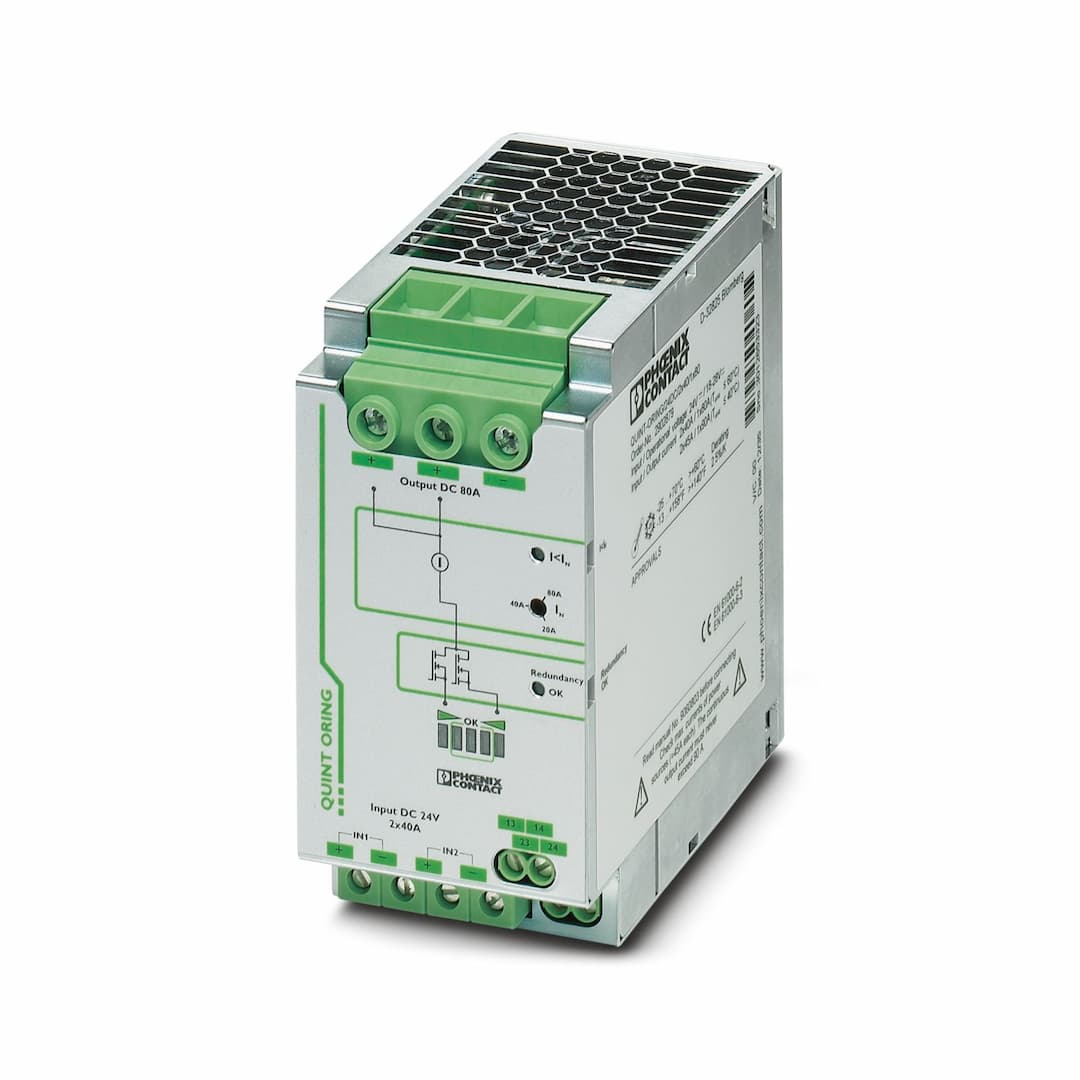
Key Features
- 1The Auto Current Balancing ACB technology ensures uniform load distribution, doubling the service life of redundantly operated power supplies.
- 2MOSFETs help save up to 70% energy, making it an efficient solution for power supply needs.
- 3The module includes monitoring functions for continuous redundancy checks and maintenance alerts.
- 4Automatically distributes load current symmetrically, ensuring consistent redundancy up to the load.
- 5Designed for easy installation on DIN rail, making it a versatile solution for various industrial applications.
Technical Specifications
Detailed engineering parameters based on manufacturer documentation
| Parameter | Value | Parameter | Value |
|---|---|---|---|
| Nominal input voltage range | 24 V DC | Input voltage range | 18 V DC ... 28 V DC (SELV) |
| Input voltage range DC | 18 V DC ... 28 V DC (SELV) | Voltage type of supply voltage | DC |
| Reverse polarity protection | < yes60 V | Nominal input current (I | 2x 40 A (-25 °C ... 60 °C)
1x 80 A (-25 °C ... 60 °C) |
| Maximum current I | 2x 45 A (-25 °C ... 40 °C)
1x 90 A (-25 °C ... 40 °C)
215 A (12 ms, SFB Technology) | Transient surge protection | Varistor |
| Voltage drop, input/output | 0.2 V (I | Efficiency | > 98 % |
| Nominal output voltage | U | Nominal output current (I | 80 A (Increasing power)
40 A (Redundancy) |
| Derating | 60 °C ... 70 °C (2.5 %/K) | Protection against overvoltage at the output (OVP) | ≤ 32 V DC |
| Power loss nominal load max. | 16 W (I | Connection in series | no |
| Output description | Group contact | Maximum switching voltage | max. 30 V AC/DC |
| Maximum inrush current | ≤ 100 mA (short-circuit-proof) | Output description | Contact closed: Δ U |
| Maximum switching voltage | max. 30 V AC/DC | Maximum inrush current | ≤ 100 mA (short-circuit-proof) |
| Maximum inrush current | ≤ 100 mA (short-circuit-proof) | Connection method | Screw connection |
| Conductor cross section, rigid min. | 0.5 mm² | Conductor cross section, rigid max. | 16 mm² |
| Conductor cross section flexible min. | 0.5 mm² | Conductor cross section flexible max. | 16 mm² |
| Conductor cross section AWG min. | 6 | Stripping length | 10 mm |
| Screw thread | M4 | Tightening torque, min | 1.2 Nm |
| Tightening torque max | 1.5 Nm | Connection method | Screw connection |
| Conductor cross section, rigid min. | 0.5 mm² | Conductor cross section, rigid max. | 35 mm² |
| Conductor cross section flexible min. | 0.5 mm² | Conductor cross section flexible max. | 35 mm² |
| Conductor cross section AWG min. | 2 | Stripping length | 18 mm |
| Screw thread | M5 | Tightening torque, min | 2.5 Nm |
| Tightening torque max | 4.5 Nm | Connection method | Screw connection |
| Conductor cross section, rigid min. | 0.2 mm² | Conductor cross section, rigid max. | 6 mm² |
| Conductor cross section flexible min. | 0.2 mm² | Conductor cross section flexible max. | 4 mm² |
| Conductor cross section AWG min. | 16 | Conductor cross section AWG max. | 10 |
| Stripping length | 10 mm | Screw thread | M3 |
| Tightening torque, min | 0.5 Nm | Tightening torque max | 0.6 Nm |
| Conductor cross section, rigid min. | 0.2 mm² | Conductor cross section, rigid max. | 6 mm² |
| Conductor cross section flexible min. | 0.2 mm² | Conductor cross section flexible max. | 4 mm² |
| Conductor cross section AWG min. | 24 | Conductor cross section AWG max. | 10 |
| Screw thread | M3 | Tightening torque, min | 0.5 Nm |
| Tightening torque max | 0.6 Nm | Types of signaling | Relay contact, floating, current limited |
| Status display | LED redundancy OK | Note on status display | green |
| Status display | ACB OK LED | Note on status display | LED bar graph green |
| Insulation voltage input, output / housing | 500 V | Product type | Redundancy module |
| Product family | QUINT ORING | MTBF (IEC 61709, SN 29500) | > 720000 h (40 °C) |
| LED | yes | Article revision | 03 |
| Protection class | III | Degree of pollution | 2 |
| Width | 66 mm | Height | 130 mm |
| Depth | 125 mm | Horizontal pitch | 3.7 Div. |
| Installation distance right/left | 5 mm / 5 mm | Installation distance top/bottom | 50 mm / 50 mm |
| Width | 122 mm | Height | 130 mm |
| Depth | 69 mm | Mounting type | DIN rail: 35 mm |
| Assembly note | alignable: P | Mounting position | horizontal DIN rail NS 35, EN 60715 |
| Housing material | Metal | Type of housing | Aluminum (AlMg3) |
| Hood version | Galvanized sheet steel, free from chrome (VI) | Degree of protection | IP20 |
| Ambient temperature (operation) | -25 °C ... 70 °C (> 60 °C Derating: 2,5 %/K) | Ambient temperature (storage/transport) | -40 °C ... 85 °C |
| Ambient temperature (start-up type tested) | -40 °C | Maximum altitude | 2000 m
2000 m |
| Climatic class | 3K3 (in acc. with EN 60721) | Max. permissible relative humidity (operation) | ≤ 95 % (at 25 °C, non-condensing) |
| Shock | 18 ms, 30g, in each space direction (according to IEC 60068-2-27) | Vibration (operation) | < 15 Hz, amplitude ±2.5 mm (according to IEC 60068-2-6)
15 Hz ... 150 Hz, 2.3g, 90 min. |
| Standard – Electronic equipment for use in electrical power installations and their assembly into electrical power installations | EN 50178/VDE 0160 (PELV) | Standard - Electrical safety | EN 60950-1/VDE 0805 (SELV) |
| Standard – Safety extra-low voltage | IEC 60950-1 (SELV) and EN 60204-1 (PELV) | UL approvals | UL/C-UL listed UL 508
UL/C-UL Recognized UL 60950-1
UL ANSI/ISA-12.12.01 Class I, Division 2, Groups A, B, C, D (Hazardous Location) |
| SIL in accordance with IEC 61508 | 0 | Electromagnetic compatibility | Conformance with EMC Directive 2014/30/EU |
| Low Voltage Directive | Conformance with Low Voltage Directive 2014/35/EC | EMC requirements for noise emission | EN 61000-6-3
EN 61000-6-4 |
| EMC requirements for noise immunity | EN 61000-6-1
EN 61000-6-2 | Standards/regulations | EN 61000-4-2 |
| Contact discharge | 8 kV (Test Level 4) | Discharge in air | 15 kV (Test Level 4) |
| Comments | Criterion B | Standards/regulations | EN 61000-4-3 |
| Frequency range | 80 MHz ... 1 GHz | Test field strength | 20 V/m (Test Level 3) |
| Frequency range | 1 GHz ... 2 GHz | Test field strength | 10 V/m (Test Level 3) |
| Frequency range | 2 GHz ... 3 GHz | Test field strength | 10 V/m (Test Level 3) |
| Comments | Criterion A | Standards/regulations | EN 61000-4-4 |
| Input | 2 kV (Test Level 3 - asymmetrical) | Output | 2 kV (Test Level 3 - asymmetrical) |
| Signal | 2 kV (Test Level 4 - asymmetrical) | Comments | Criterion B |
| Standards/regulations | EN 61000-4-5 | Input | 0.5 kV (Test Level 1 - symmetrical)
0.5 kV (Test Level 1 - asymmetrical) |
| Output | 0.5 kV (Test Level 1 - symmetrical)
0.5 kV (Test Level 1 - asymmetrical) | Signal | 1 kV (Test Level 2 - asymmetrical) |
| Comments | Criterion B | Standards/regulations | EN 61000-4-6 |
| I/O/S | asymmetrical | Frequency range | 0.15 MHz ... 80 MHz |
| Comments | Criterion A | Voltage | 10 V (Test Level 3) |
| Standards/regulations | EN 61000-6-3 | Radio interference voltage in acc. with EN 55011 | EN 55011 (EN 55022) Class B, area of application: Industry and residential |
| Emitted radio interference in acc. with EN 55011 | EN 55011 (EN 55022) Class B, area of application: Industry and residential | Criterion A | Normal operating behavior within the specified limits. |
| Criterion B | Temporary impairment to operational behavior that is corrected by the device itself. |
Specifications may be subject to change without notice